

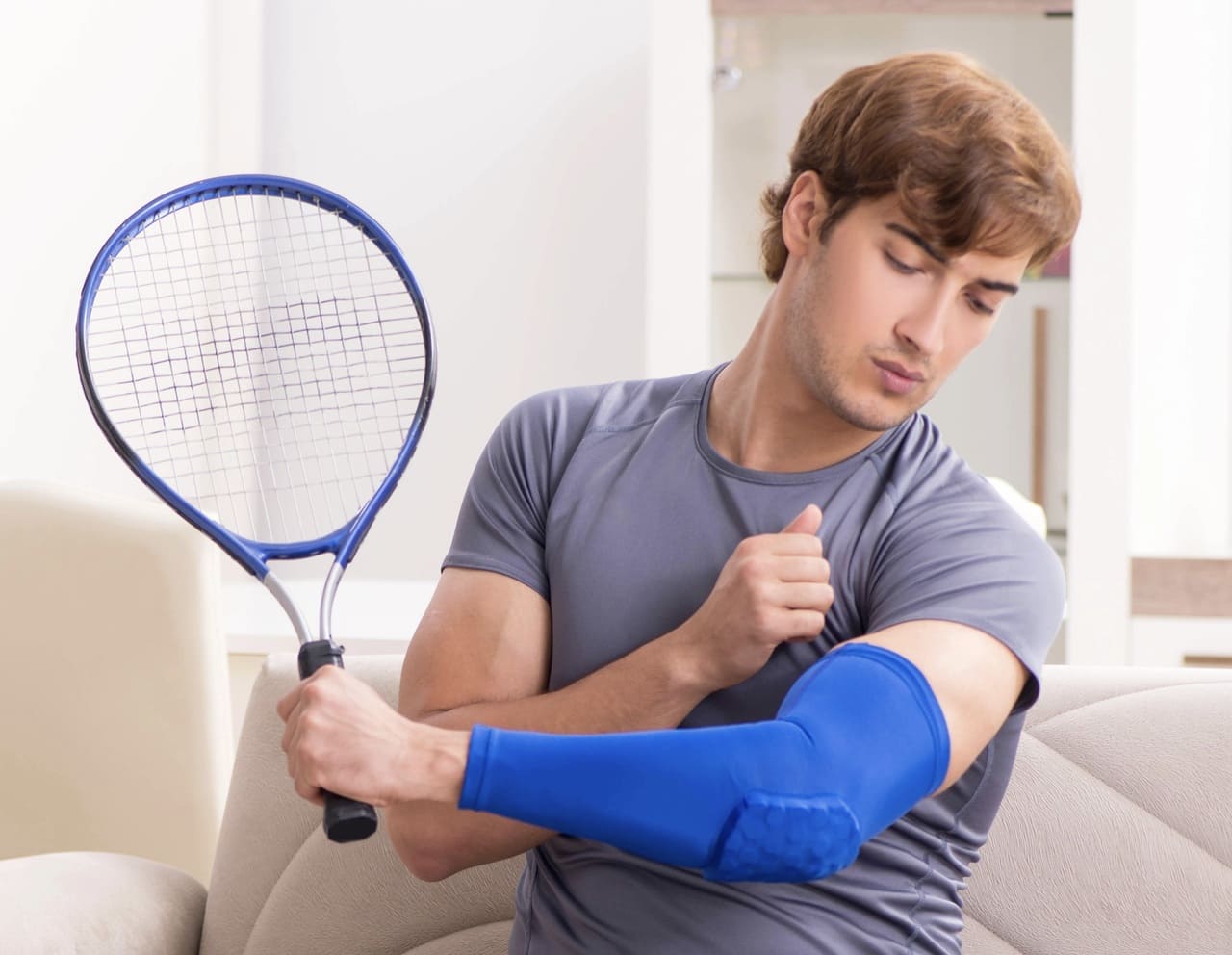
Tennis elbow is one of those frustrating injuries that just doesn’t seem to go away.
We see it all the time—people who’ve had elbow pain for months, sometimes longer. It affects everything: lifting, typing, even something as simple as pouring a coffee.
At some point, many patients are offered injections as the next step. It sounds appealing—quick relief, minimal effort.
But the real question is: does it actually help long-term?
Lets take a look at a recently published study looking to answer this question
What the Study Looked At
Researchers followed 60 patients with chronic tennis elbow and compared three treatment approaches:
- Exercise only (heavy slow resistance training)
- Exercise + corticosteroid injection
- Exercise + tendon needling
All patients completed a 12-week strengthening program, and outcomes were tracked for up to 1 year.
The Key Finding: Exercise Did the Heavy Lifting
Across all groups, patients improved significantly in:
- Pain levels
- Strength
- Function
But here’s the important part:
Adding injections or needling did NOT lead to better long-term results compared to exercise alone.
In fact:
- At 1 year, outcomes were essentially the same
- In some cases, the injection group had worse patient-reported outcomes over time
The “worse” outcomes refers to an interesting result they found when looking at blood flow within the tendons at the 1 year mark. Those with cortisone had less blood flow at the site of injection, they referred to this as decreased hypervascularization.
This finding is very important because blood flow, is in many ways, the fountain of youth to recovery of an injury. When tissues have poor blood flow, they tend to take longer to recover or are more vulnerable.
What About Short-Term Relief?
Corticosteroid injections did show some early improvements, particularly in reducing inflammation markers.
However:
- These benefits did not last long-term
- They did not outperform exercise alone
This highlights a common issue in medicine: Some treatments feel better quickly, but don’t actually fix the underlying problem.
What This Means for You
If you’re dealing with persistent elbow pain:
The most effective long-term strategy:
- A structured, progressive strengthening program
Be cautious with quick fixes:
- Injections may reduce pain temporarily
- But they don’t appear to improve long-term recovery—and may even delay it
Why Exercise Works Better
Tendon injuries are not just “inflammation” problems—they are load tolerance problems. The inflammation is a result of the problem!
Heavy, controlled resistance training helps:
- Stimulate tendon healing
- Improve strength and resilience
- Reduce recurrence risk
In other words, it addresses the root cause, not just symptoms.
Should we completely avoid injections?
Not necessarily. The take-away point is that the best approach is a combined approach where the fundamental priority is strength training. In many cases, cortisone is needed for a short term relief BUT we must still emphasize the rebuilding of the tendon’s health through exercise.
Remember: cortisone alone is a quick relief and may not resolve the underlying problem.
Reference study: Couppé C, Døssing S, Bülow PM, Siersma VD, Zilmer CK, Bang CW, Høffner R, Kracht M, Hogg P, Edström G, Kjaer M, Magnusson SP. Effects of Heavy Slow Resistance Training Combined With Corticosteroid Injections or Tendon Needling in Patients With Lateral Elbow Tendinopathy: A 3-Arm Randomized Double-Blinded Placebo-Controlled Study. Am J Sports Med. 2022 Aug;50(10):2787-2796. doi: 10.1177/03635465221110214. Epub 2022 Jul 22. PMID: 35867777. Link